Wednesday, December 27, 2017

The Last Pitch

The a capella songbirds of the Barden Bellas reunite for one last hurrah in ‘Pitch Perfect 3,’ the third and thankfully final installment of a trilogy that’s been fresh out of ideas since the original surprise hit back in 2012.  That’s the thing with surprise “sleepers” that exceed expectations critically and commercially; we can expect sequel(s) that in the vast majority of cases fail to equal—much less surpass—the original.  PP3 is only the latest example of forced and unwanted trilogies, but we can hardly fault them for trying from a strictly business standpoint.
 
PP3 picks up sometime after PP2 and finds the Bellas out of their league in a competition against seasoned professional bands (with instruments) for the opportunity to perform as part of an overseas USO tour hosted by DJ Khaled.  Unlike PP1 and PP2, however, there isn’t much of a contest this time because all the singing and improv-ing took a backseat to an unexpected action-comedy script centered on “Fat Amy” (Rebel Wilson) and her estranged criminal dad (John Lithgow).  This ill-conceived diversion sucked away much of what made the original (and PP2 to a lesser degree) so charming and delightful because PP3 made for a poor action-comedy.
 
Like other unnecessary sequels, it is probably unavoidable that PP3 would have suffered from the “law of diminishing returns” no matter what, but it didn’t have to go out with such a depressing note.  The only notable musical performance in the entire film was an unimaginative cover of Britney Spears’s “Toxic.”  While I wasn’t expecting much out of PP3, at least I was hoping for some decent a capella singing.  Sadly even that was too much to ask.

Grade: C-

pp3-teaser-onesheet-594da88174a10-1

Never give up, never surrender

There is no greater embodiment of British steadfastness and defiance against Adolf Hitler than Winston Churchill, the rotund cigar-chomping prime minister responsible for steering England through her “darkest hour” in the early days of World War II, a time when Germany’s war machine and blitzkrieg through Europe seemed well-nigh unstoppable.  British director Joe Wright’s Churchill biopic ‘Darkest Hour,’ based on a screenplay by Anthony McCarten, sought to capture the essence of the man as well as the public and backroom politicking which took place at a time when negotiations (“appeasement”) and the pursuit of peace at the cost of British honor would appear to be the easy way out.
 
It is widely accepted in Hollywood that one role can often define a career, and this is surely the case for veteran actor Gary Oldman, who delivered the performance of his lifetime as Winston Churchill.  Oldman had always been a somewhat underappreciated method actor whose previous roles failed to fully do justice to his abilities, but ‘Darkest Hour’ gave him the perfect vehicle to showcase his talents, resulting in a bravura performance that will likely earn him an Oscar nod (if not outright win) in the Best Actor category next February.
 
While ‘Darkest Hour’ will no doubt appear stuffy and slow to younger viewers who regard history and biopics as a bit of a bore, I find it to be an excellent snapshot of World War II history and a fascinating character study of one of Britain’s greatest political figures.  Even as a WWII buff I found the movie to be enlightening, as I didn’t know just how close even Churchill was to giving in to the political pressures from Halifax and Chamberlain to make peace with Hitler during the Dunkirk disaster.

Grade: A
 
Darkest_Hour

Monday, December 18, 2017

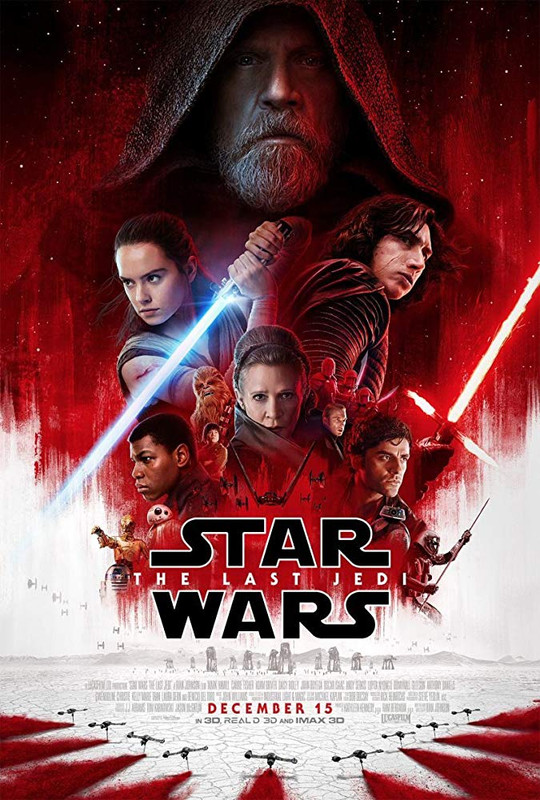
The First Order Strikes Back

‘Star Wars: The Last Jedi,’ the middle installment of the new Disney Star Wars trilogy and Episode VIII of the Star Wars saga started by George Lucas 40 years ago, is the best movie of the popular and beloved space opera franchise since ‘The Empire Strikes Back’ according to the critics who raved about it, giving it a “certified fresh” rating of 93 percent on the aggregate review website Rotten Tomatoes.  Audiences are divided and decidedly less enthused, as its current audience score closer to 50 percent would suggest.  Why the disconnect?  Inquiring minds want to know: The Great Star Wars Divide.
 
By any measure, TLJ seems to have checked off most—if not all—of the boxes one would expect in a Star Wars movie.  It is packed with thrilling action in space and on the surface, filled with individual acts of derring-do and noble sacrifice, spiced with a good dose of humor and topped off with the good-versus-evil melodrama that had become its trademark.  While there isn’t anything in TLJ that truly can be called surprising (such as—spoilers ahead!--Kylo Ren’s manipulation of Rey for his own ends, his betrayal of Snoke, or the twist in Luke’s final “appearance” on Crait) and the story is somewhat reminiscent of TESB, TLJ still managed to be a rollicking, entertaining and crowd-pleasing adventure yarn, porg or no porg (just don't eat them).
 
Alas, when an event movie from as popular a pop culture phenomenon as Star Wars comes along, it is inevitable that there will be a high degree of anticipation and expectations from diehard and casual fans alike.  And if the movie falls short of said expectations, well, then the movie had failed to the individuals concerned.  It can be a subjective and highly personal experience.  With this in mind, I’ll jump off the fence and side with the critics on this one.

Grade: A
  
TLJ

Monday, December 11, 2017

How to make a bad movie

In the annals of cinema’s long and storied history, one would be hard pressed to find a movie as bad as Tommy Wiseau’s ‘The Room.’  Released in the summer of 2003, this so-called “movie” still holds the dubious distinction of being the worst movie ever made, which makes its subsequent cult status as the ‘Rocky Horror Picture Show’ of bad movies all the more baffling.  It’s so bad that it’s awesome?  I didn't get it.  But now I think I do, thanks to James Franco’s new mockumentary (or could it be homage?) ‘The Disaster Artist’ about the making of the notorious film and Wiseau himself.
 
In many ways, ‘The Disaster Artist’ is a charming, heart-felt and poignant portrait of friendship between the movie’s two main characters, Wiseau (James Franco) and Greg Sestero (his real-life brother Dave), two struggling wannabe actors who, like Mia in ‘La La Land,’ dream of making it big in Hollywood.  With ambitions far outstripping whatever acting skills they possess (none to speak of), they found it hard—big surprise—to break into show business, so Wiseau decided that the best way to overcome this obstacle is to produce, star in and direct his own movie.  Six months and six million dollars (bankrolled out of Wiseau’s own pocket because no sane person would even consider financing it) later, ‘The Room’ was the result and the world will never be the same because of it.

James Franco was simply Fabio-lous as the eccentric and pathological Wiseau, a big baby who refused to be type-cast as a villain just because he resembled Dracula with his long dark locks and faux Transylvanian accent (he’s a hero!).  Dave Franco was equally great as Sestero, the ying to Wiseau’s yang, as their (non-homo) bromance was put to the test by increasing difficulties and strains on and off the set.  In our age of MST3K and Rifftrax, there will always be room (excuse the pun) for horrendously bad movies like ‘The Room’ among cinephiles and film geeks alike, but unlike its subject, ‘The Disaster Artist’ is “tearing us apart” not because of how much it blows (which it doesn’t) but because it is so subversively funny at times that it drives us to tears.
 
Grade: A+
 
TDA

Tuesday, December 5, 2017

Billboard Justice

Character-centered films spare in visual pizzazz yet rich in storytelling and character development are all too rare these days in a movie industry driven by blockbusters and spectacle-heavy extravaganzas.  It is therefore such a welcome breath of fresh air when a black dramedy like Martin McDonagh’s ‘Three Billboards Outside Ebbing, Missouri’ comes along, a low-key affair relying on great storytelling and strong characterizations that leaves an imprint long after the final credits have rolled.
 
‘Three Billboards’ thrives on conflict and a good dose of trouble, which arose when grieving and angry mother Mildred Hayes (Frances McDormand in what may be her best performance since ‘Fargo’) donned the hat of town hell raiser by renting three billboards outside the fictional, run-down town of Ebbing, Missouri to advertise her frustration at the failure of local law enforcement to apprehend the murderer and rapist of her rebellious teenage daughter.  An understandable grievance to be sure, but for the fact that her ire happened to be directed towards Chief Bill Willoughby (Woody Harrelson), the beloved town sheriff and loving family man cast in the homespun mold of Andy Griffith and Carroll O’Connor.  Considering that justice was denied in this case not due to negligence, incompetence or a failure to conduct the investigation with due diligence but simply because the trail had gone cold and nothing else can be done, it’s little surprise that a majority of the townsfolk turned against Mildred, particularly in light of the fact that Chief Willoughby is dealing with a serious health issue of his own.  Nevertheless, on a mission with a single-mindedness bordering on sheer fanaticism, Mildred continued to wage her righteous crusade against the police like the scorned woman she is.
 
What’s great about ‘Three Billboards’ is that it defied our expectations with its ambiguous, shades-of-grey morality.  At times as cold as ice, McDormand made it hard for the audience to fully empathize with Mildred despite what she’s going through.  While most people would probably have found some kind of closure and tried to move on with their lives, Mildred adamantly refuses to let it go, come hell or high water.  And (speaking of which) like last year’s uniquely American neo-western/black comedy ‘Hell or High Water,’ she’s willing to let her destructive actions take her wherever they may lead, leaving the rest to the audience’s imagination and judgment.

Grade: A+

three_billboards_outside_ebbing_missouri_xlg

Tuesday, November 21, 2017

Justice Denied

Pity DC.  Just when its cinematic universe, the so-called DC Extended Universe or DCEU, appears to be on the right track, finally putting its critical and box office troubles behind with the sensational success of the female-empowering ‘Wonder Woman’ this past summer, things came crashing back to harsh reality in ‘Justice League,’ DC/Warner Brothers’ highly anticipated super-powered team that’s supposed to be DC’s answer to Marvel’s ‘Avengers.’  Boasting such heavyweights as Wonder Woman, Batman, Aquaman, Flash, Cyborg and Superman (yes, he’s baaack!), you would think that JL should have little trouble crossing $100 million at the domestic box office on opening weekend with no major competition (‘Thor: Ragnarok’ is in its third weekend) in sight, but as the final tally came in, it appears that anything is possible.
 
To be fair, JL had what we might call “bad karma.”  One of its production companies is Ratpac Entertainment co-founded by Brett Ratner who, along with his mentor rap mogul Russell Simmons, finds himself accused of sexual misconduct in the current enlightened Hollywood climate. While women went in droves to see ‘Wonder Woman,’ most seem to have stayed away from JL despite Gal Gadot reprising her role in it.  Moreover, director Zack Snyder was forced to leave the set in May 2017 due to a family tragedy (his daughter’s suicide), leaving the unfinished tentpole in the more-than-capable hands of fan fave Joss Whedon (‘The Avengers,’ ‘Age of Ultron,’ ‘Agents of SHIELD, BTVS, Firefly, etc.).  In light of Snyder’s track record (‘Man of Steel,’ ‘BvS: Dawn of Justice') in the DCEU, this change may be taken as a blessing in disguise, but even Joss isn’t Superman and only re-shot some scenes (ballooning the movie’s budget well north of $300 million), having little creative input at this late stage of the film’s development.  As a result, JL is plagued by everything the critics have mentioned: inconsistent tone and pacing, a paper-thin plot, underdeveloped characters, subpar FX, and topping it all off is a weak ass villain named after a short-lived '70's Canadian rock group.  Quite disappointing.
 
DC/Warner Brothers really had to bring its "A game" to JL in order to try and catch up to Marvel, but instead of doing justice to ‘Justice League’ it laid an egg while second tier Marvel characters routinely perform better.   How?  Movie analysts and DC fanboys alike are still scratching their collective heads on this one.  Is it because there are simply too many superhero movies out there ("superhero fatigue"), or is it because mainstream audiences just don't find DC characters all that interesting, with the notable exceptions of Superman, Wonder Woman and Batman?  I guess we'll find out in due course when Aquaman and Shazam get their stand‑alone movies.

Grade: C
 
league-poster-sdcc-2017

Poetic Justice on the Orient Express

Kenneth Branagh stars and directs in the latest movie adaptation of Agatha Christie’s ‘Murder on the Orient Express’ featuring Belgian detective extraordinaire Hercule (not Hercules) Poirot, perhaps fiction’s most famous detective not named Sherlock.  Which begs the question “Why???!!!” because all one has to do is to watch (or revisit) the superb 1974 original directed by Sidney Lumet starring Albert Finney, Lauren Bacall, Ingrid Bergman, Sean Connery and Vanessa Redgrave.  The answer is simple and pretty much the same whenever a “classic” is shamelessly thus remade: Hollywood may be creatively bankrupt and has to recycle old material every now and then, but it is also doing us a service by updating these classics for later generations of moviegoers who – unless they’re classic film buffs – would not have seen them in the first place.  A valid reason or an excuse?  You decide.

Nonetheless, many critics declared this “unnecessary” remake utterly pointless and DOA (58 percent on the Tomatometer), but MOTOE2017 actually holds up on its own quite well.  You would think that finding a cast that would do justice to an ensemble including such screen legends as Bacall, Bergman and Redgrave is no mean feat (which it isn't), but MOTOE2017 came pretty darn close with a power-house cast of its own featuring Judi Dench, Michelle Pfeiffer, Johnny Depp, Willem Dafoe and Branagh himself as the eccentric and mustachioed detective.  Am I being too lenient?  You decide.

If you’ve read the AC novel or seen the 1974 movie (or even both), there is likely no suspense here as to “Whodunit.”  Even the play on words that formed the title of this review kind of gives it away.  But like the namesake of its mode of transportation, it’s the journey and not the destination that matters.  Then again, I may be predisposed towards MOTOE2017 because I’m just a sucker when it comes to a good old fashioned “dinner party murder mystery.” 

Grade: A-

MOTOE